I was in the fortunate position recently to be new-car shopping. This time around I decided to go a bit more up-market than everything I've owned in recent history. It was a long list to start with but in the end it boiled down to these four vehicles : Audi Q5, BMW X1, Mercedes GLK and Range Rover Evoque.
I was able to test drive all the vehicles within a few days of each other so I was able to make a fairly good comparison between them. The most disappointing of all was the Mercedes. It was smaller inside than my VW Tiguan, the controls were extremely peculiar in their layout and it really didn't drive very well. The 3.0 V6 was perky enough, but the whole package felt a bit numb.
The BMW X1 was ruled out almost before the test drive. It too was small inside - so small that with the seat in a good driving position for me, I wouldn't be able to carry any passengers in the back, and I regularly have three or four people in my car. On top of that, the plastics they've used inside felt cheap and hard and scratchy, and the centre console layout was very 1980's. Plus it had that awful iDrive computer. The drive wasn't much better. Vague steering, vague throttle response, vague brakes. Not at all what I was expecting from BMW.
The Audi rose to the top of the pile simply by virtue of not being eliminated. The drive was lovely, the layout inside was very familiar because of my ownership of the VW Tiguan. Everything was just-so. The steering had the same unusual electro-mechanical feel to it as my VW (which I'm used to) but it was nowhere near as disconnected from the wheels as the Mercedes or the BMW. In all it's a brilliant car, even if I'm not sold on the jelly-mould shape of the exterior.
Finally, the Range Rover Evoque had a drive that, for me, belied its size. It's more nimble than any of the others (in so far as any crossover can be 'nimble'), the interior was a bloody nice place to be, and the steering, brakes and throttle were all quite similar in overall feel to my VW, and the Audi. Not great, but not wooden. The big downside is the tiny slit that masquerades as a rear window, but I was willing to overlook that for two reasons. First, all US-spec Evoques come with a backup camera as standard, and second, my second ever car was an Audi Quattro that had a similarly tiny rear view when looked at in the mirrors. That's to say - I'm used to it.
The Audi is certainly the pick of the bunch if I was to pick with my head. But I've done that for so many cars now that I decided to throw caution to the wind and pick the Evoque with my heart instead. Time will tell if this was a wise choice, or if it's going to be something I'll look back on as "one of life's rich experiences".
Monday, April 15, 2013

Monday, April 8, 2013
The mpg question: why is diesel so unpopular in the US?
A few weeks back I talked about a VW Golf that we rented whilst on a trip to the UK. It returned an impressive 88mpg - about 73mpg in US gallons. That's a car you can own and drive today - not some fly-by-night fantasy or future concept. Yes, it's a diesel, yes it has VW's package of fuel economy add-ons (low-resistance tyres, streamlined underbody, stop/start etc) but it's all entirely usable technology right now.
Meanwhile, here in the colonies, we struggle to get 40mpg out of a passenger car and 25mpg out of an SUV is a total miracle. I'm talking about real-world figures here, not the rose-tinted view of the world that the EPA live in where nobody drives in the cold, or up and down hills, or in traffic, or at night, or above 57mph. Heck if you drove that Golf at 57mph with all the electrical items turned off I reckon it would top 80mpg U.S.
I've never really understood why America hasn't taken to diesels. My best guess is that the US-built diesels of the 80's are probably what put most consumers off. Rattly, dirty, noisy beasts that sounded like a 1950's train. But modern diesels are so much better. With the soot and particulate filters and all the other technologies in the engine, they get stellar mpg numbers and in most cases (if you use low-sulphur diesel) are now cleaner than petrol cars for the same engine size. VW knows this - it's why they have the broadest range of diesels of any manufacturer selling cars in the US. Jeep seem to be catching on now - they're going to offer a diesel engine in their range this coming year, but I suspect the old biases will be tough to get past and I don't think diesels will ever really be as popular here as they are in Europe.
The bizarre thing is, of course, that now diesel is so expensive in Europe, people are starting to swing back the other way to hyper efficient petrol-engined cars. Small turbo engines with direct-injection technology are as driveable as any petrol engine you're used to but return diesel-like gas-mileage numbers. Yet again, even with that technology around right now, we still struggle here in the US.
Is it consumer apathy or lack of demand? Is it the low petrol prices? Or is it that vehicle tax over here is still based on the value of the vehicle (in most states) instead of the exhaust emissions? I guarantee if that changed, people would be begging and screaming for properly fuel-efficient engines in their cars....
Monday, April 1, 2013
Self driving cars, again
Another week, another study.
The latest study into self-driving cars has stated that "The thought is that autonomous cars will reduce the number of traffic deaths — more than 100 people per day, currently". Marketing doublespeak might make you think that they mean self-driving cars would save 100 lives per day. Actually, what it means is that currently 100 people a day are killed in car accidents, and that that number might be reduced, but they don't guesstimate by how much.
In truth the same could easily be achieved much more effectively by proper driver training and annual re-assessment. We don't license airline pilots and train drivers once and then leave them to it - they get annual or bi-annual re-assessments. They're human just like you and me, yet in America we're allowed to take an open-book written test in some states, and shockingly, people still fail even when they're given the answers. That's followed by 8 minutes of the dumbest driving test in the history of the universe and then no re-testing until we're dead.
The key phrase in that study was "the thought is". We thought the earth was flat at one point too, and millions of people think American Idol is important (hint: it's not).
In America, we have an appallingly easy mechanism of getting untalented, unprepared drivers on to the road, reflected in the accident rate here. 8.5 fatalities per billion road kilometres driven (a good metric - it takes into account population, number of cars, number of drivers and distances driven). In Sweden, where the driver licensing mechanism can take a year, that number is 5.1. In the UK where driver training takes months and the test is phased, it's 5.7. In fact, the only places in the world with a higher fatality rate than the US are places like Latvia, Estonia and Slovakia (Source).
So trying to sell the idea that automated cars will somehow "fix" the accident rate in the US ignores that fact that the driver licensing mechanism is totally broken. Fix that and the accident rate will drop naturally. It's a lot cheaper and doesn't require the wholesale replacement of every vehicle on the road.
That's a serious point - unless every car on the road has this technology, it simply won't work. Say you're in a self-driving car and it sees something and performs an emergency stop. I'm behind you in a normal car and I can't react anything like as quick as your computer. I slam into the back of you with enough speed that my airbags deploy and I shunt your car forwards into whatever it was trying to avoid. That's a very common accident right now and there's nothing your self-driving car can do to prevent that accident.
That assumes the tech works in the first place. Case in point: Volvo's new auto-braking system - exactly what I just described above.
It failed spectacularly at this press event because of "battery issues". Mercedes have problems too. The UK TV Show 'Fifth Gear' recently tested their auto emergency braking system and in every instance (slow, 18mph, 28mph and 60mph) it hit the car in front. Sure they can iron out the bugs - I'm not a total luddite - but ultimately, demonstrations like this prove that even when everything ought to have be set up perfectly, it can still go wrong. And that's my point - if you can't rely on this technology 100% of the time, it shouldn't be being put into cars. Heck - ABS has been around for decades and that still has problems (gravel, snow, ice, mud etc). The last generation Ford Mustang had ABS that would fail when it was raining - the one time you might actually need it.
Look at Google's self-driving cars - loaded up with sensors, cameras, radars, lasers and computers yet they can't merge on and off motorways (they can't figure out speed differences and sizes of prospective gaps for the car) and they can't drive any route that hasn't been pre-driven and stored in GPS. So they're not really autonomous at all - they're simply playing back pre-driven routes.
There's dozens if not hundreds of other examples where this technology, impressive as it is, simply isn't working.
Parallel parking a car is about the easiest thing you can do - it's a low speed geometrically simple problem and you ought to be able to do it pretty much in your sleep. Yet they haven't been able to make a car that can do that reliably. The ones that attempt it have a manual an inch thick telling you all the things you need to do to "prepare" the car for the maneuver and even then it'll fail 6 times out of 10. Do you really want to rely on a car to save you, to think for you, to make decisions for you? When they can't even make a car that can reliably parallel park, I don't.
Monday, March 25, 2013
Be honest - let the buyer decide.
A couple of weeks ago I was browsing the VW website looking at the specs for the next model year Tiguan and I came across a 'compare' link. I figured it was a comparison with other models in their line up but it turned out not to be. It is a comparison against other crossover / mini SUVs from their competition. What is interesting is that they haven't done the usual thing, which is to pick comparison categories they could easily win. Instead it is a short list of some of the most common things buyers look for when buying a car, and what is very enlightening is that the Tiguan only comes out on top in two of the five categories - power and servicing costs. For mpg, leg room, cargo space and front crash test performance it comes out worse. Bear in mind this is on VW's own corporate website - not a car shopping or comparison site.
I find this refreshing because, however it was intended, it shows me that VW don't mind being a little more honest about their vehicles. How many times have you seen cross-manufacturer comparisons where they pick categories they know their vehicle is better at - inconsequential things like numbers of cup holders, tint on the windows and things like that? Or worse, where the competitor comparison numbers are altered to make them seem worse?
Here I'm faced with a chart that tells me the vehicle I'm interested in does pretty badly for cargo space compared to its competition. It also isn't brilliant for gas mileage, but by giving me the details up front, I'm being allowed to make an informed choice. Would I go elsewhere for this sort of vehicle? Potentially yes. For example I'd not really considered the Rav4. However the thing I get a kick out of the most - the turbo-assisted power in my current Tiguan - is where it does win out handily over the others in this particular list, and that alone is enough to sway me back into the VW camp. That's why the mpg is worse - because the engine is a lot more 'fun' to play with :-)

Monday, March 18, 2013
Safer cars mean worse drivers
If you've read my blog for any length of time you might remember that I subscribe to the theory that safer cars make for worse drivers. My argument all along has been that when you seal people into a quiet cocoon full of entertainment gear, surrounded by safety aids, the drivers begin to assume that the car will save them from their own bad driving. (most recently, see the Driver Education and Toyota Wants To Steer For You posts)
It seems that my theory on this actually has some substance. New research suggests just that - extra safety equipment in cars gives drivers a false sense of security and leads to them taking more risks.
The TRL (Transport Research Laboratory) in England studied crash statistics from 2000 to 2010 and statistical models were developed to look at casualty trends and the effects of car secondary safety improvements. They discovered that, while the number of people seriously injured in road accidents dropped for the first six years of that period, the number of fatalities barely changed. Bear in mind that during the same period there were great improvements in car safety levels with the introduction of more airbags and standard ABS, stability control and traction control on most cars. On higher-end vehicles, things like preemptive braking, radar-assisted cruise control and lane departure warning systems were also becoming commonplace. That all resulted in an increasing number of cars being awarded a five-star crash test safety rating by Euro NCAP.
These advances should have cut fatality rates, but the report's authors warn increasing safety levels may have been counter-productive:
"The reason that the fatality trend was not decreasing up to 2006... may be due to driver confidence – additional safety features in and on vehicles provide additional confidence and some drivers may have adapted their behaviour (ie drive more recklessly) as a result."
The report does go on to say that after 2006, fatalities dropped although the analysis shows that this is most likely because the economic downturn which appears to have had a beneficial effect on driver behaviour, with less speeding and drink driving. The decrease in overall traffic also contributed, especially the large reduction in HGV traffic, and a fall in the number of young male drivers.
The report is available on the TRL website for a small fee.
The TRL are not the first large study institute to come to this conclusion; the American Institute for Highway Safety published similar findings last year - you can read about those in this blog post.
This all begs the question then : why do manufacturers keep loading cars up with this stuff if it's now being proven to be of little or no use? Surely they should be removing this stuff, simplifying and lightening cars and improving fuel economy and safety as a result? Frankly, the more a driver is involved in the act of driving, the safer the roads become because concentration levels have to be higher. That's why drivers who started out on motorbikes are statistically safer car drivers, and that's why cars with manual gearboxes are involved in less accidents - motorcyclists and drivers of manual cars are both more involved in the act of driving (or riding).
Monday, March 11, 2013
Crazy Concepts - The Best Concept Cars That Never Saw the Light of Day
Some concept cars were never meant for this world; they were either too expensive to produce, or were just never designed to actually be a reality, or at least not in the immediate future. Many of the best concept cars include designs that are more abstract than practical, while others contained the germs of good ideas that would be incorporated into other car designs. Some, however, are just impressive for taking a risk on what we’d normally consider to be good car design. With this in mind, the best concept cars that never saw the light of day include:
Propeller Driven Car.

This concept was designed in 1913 by Marcel Leyat, and was notable for replacing an engine with a propeller; the car also featured spoke-less wheels and was extremely light at just 625 pounds. While it never went into full production, the propeller driven car, or the Leyat Helica to give it its full title, did make an appearance at the 1921 Paris Auto Show.
Citroen Tubik

A Type H van designed to include nine seats, the Tubik is distinguished by its sheer size - it was over 4.8 m long - and by looking like it would give most buses a run for its money. The elongated body of the car and van hybrid also contributed to its imposing frame.
Cadillac Sixteen

A 16 cylinder Cadillac with 1000 horsepower, the Sixteen was intended to demonstrate an alternative market for the brand that would make it more appealing for younger drivers; the concept’s super powered design never made it off the ground, though.
Hyundai Qarmaq

The result of a joint venture between GE and Hyundai, the Qarmaq was ahead of its time for being almost completely built using recycled plastics. The concept proved to be too expensive to build, though, although its intentions fit with today’s hybrids and electric vehicles.
Nissan Pivo

The main appeal of the Pivo came through its rotating cabin, which could turn by 360 degrees, meaning that the vehicle itself had no reverse gears. Intended as a city car that could reduce accidents, the pod style cabin remains an intriguing design idea for future cars.
Cadillac World Thorium
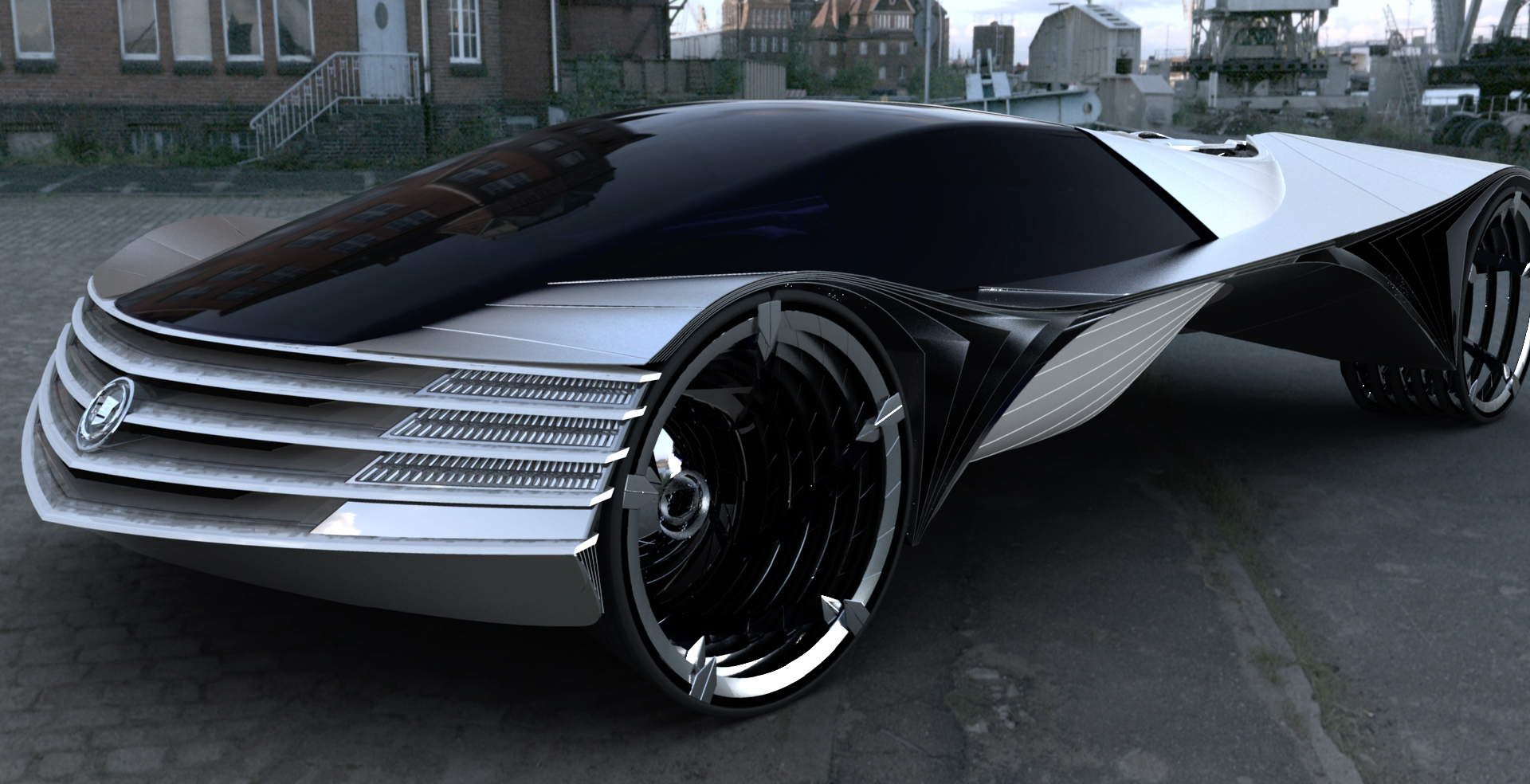
A nuclear powered car notable for having a front grill wider than the length of its body, and 16 wheels, the Thorium was predicted to last for a century without any maintenance.
Airflow Glass Car

Pierre Sabas designed this concept, which wraps an electric engine in glass, lowering the car’s suspension and allowing for four capsules to act as passenger seats. The Airflow Glass Car was intended to demonstrate the potential for a more aerodynamic design.
The Stackable Car

This concept involved adapting the idea of trolleys and bikes being ‘stacked’ in public for rental; small cars with omnidirectional movement, and no engine block or drive shaft (the motors were in the wheels) could be picked up and driven short distances.
Bentley SenseS

A futuristic concept from designer Arturo Peralta, the Bentley SenseS was used to promote biotechnology, whereby the car is uniquely linked to your own mood and biorhythms, presumably to encourage responses to speed and handling. The outside of the vehicle was pitched around using solid hologram technology.
Lexus LF-LC

The most believable of these concepts, the Lexus LF-LC concept is built by the Takumi (or “artisan”) master designers ensuring the sharpest eye for detail. The LF-LC’s leading concept appears to be, however, its next-generation hybrid technology which produces up to 500hp. Not your average Lexus, and a certainly not any cheaper than buying them used!
GM Hy-Wire

A vehicle powered by hydrogen fuel cells and by-wire technology, the GM Hy-Wire concept included a transparent glass front and rear panels, no hood, and open seat backs, allowing people to see into the workings of the vehicle’s engine.
Propeller Driven Car.
This concept was designed in 1913 by Marcel Leyat, and was notable for replacing an engine with a propeller; the car also featured spoke-less wheels and was extremely light at just 625 pounds. While it never went into full production, the propeller driven car, or the Leyat Helica to give it its full title, did make an appearance at the 1921 Paris Auto Show.
Citroen Tubik
A Type H van designed to include nine seats, the Tubik is distinguished by its sheer size - it was over 4.8 m long - and by looking like it would give most buses a run for its money. The elongated body of the car and van hybrid also contributed to its imposing frame.
Cadillac Sixteen
A 16 cylinder Cadillac with 1000 horsepower, the Sixteen was intended to demonstrate an alternative market for the brand that would make it more appealing for younger drivers; the concept’s super powered design never made it off the ground, though.
Hyundai Qarmaq
The result of a joint venture between GE and Hyundai, the Qarmaq was ahead of its time for being almost completely built using recycled plastics. The concept proved to be too expensive to build, though, although its intentions fit with today’s hybrids and electric vehicles.
Nissan Pivo
The main appeal of the Pivo came through its rotating cabin, which could turn by 360 degrees, meaning that the vehicle itself had no reverse gears. Intended as a city car that could reduce accidents, the pod style cabin remains an intriguing design idea for future cars.
Cadillac World Thorium
A nuclear powered car notable for having a front grill wider than the length of its body, and 16 wheels, the Thorium was predicted to last for a century without any maintenance.
Airflow Glass Car
Pierre Sabas designed this concept, which wraps an electric engine in glass, lowering the car’s suspension and allowing for four capsules to act as passenger seats. The Airflow Glass Car was intended to demonstrate the potential for a more aerodynamic design.
The Stackable Car
This concept involved adapting the idea of trolleys and bikes being ‘stacked’ in public for rental; small cars with omnidirectional movement, and no engine block or drive shaft (the motors were in the wheels) could be picked up and driven short distances.
Bentley SenseS
A futuristic concept from designer Arturo Peralta, the Bentley SenseS was used to promote biotechnology, whereby the car is uniquely linked to your own mood and biorhythms, presumably to encourage responses to speed and handling. The outside of the vehicle was pitched around using solid hologram technology.
Lexus LF-LC
The most believable of these concepts, the Lexus LF-LC concept is built by the Takumi (or “artisan”) master designers ensuring the sharpest eye for detail. The LF-LC’s leading concept appears to be, however, its next-generation hybrid technology which produces up to 500hp. Not your average Lexus, and a certainly not any cheaper than buying them used!
GM Hy-Wire
A vehicle powered by hydrogen fuel cells and by-wire technology, the GM Hy-Wire concept included a transparent glass front and rear panels, no hood, and open seat backs, allowing people to see into the workings of the vehicle’s engine.
Subscribe to:
Posts (Atom)