Having had Ford Sync in my long-term rental (while my car gets repaired - and yes - it IS a long time because a chunk of the parts were on back-order), I've grown to hate it in the same way that it seems most Ford owners hate it. It seems to offer so much but it is very poorly implemented.
Let's start with something simple : bluetooth audio. In the car I'm in, a 2013 Focus, you cannot default the Sync system to bluetooth audio. It always reverts to Line-In each time you start the ignition. My two previous cars have been able to do this - why can't Sync? So to choose bluetooth, I have to either navigate through 8 key presses (Sync->menu->play options->media options->source select->line-in->Bluetooth audio->enter) or I have to speak to the car. Which leads me to item #2:
Sync can't understand a damn thing I say. And it's not just me - I have an English accent so I always have trouble with voice controls (my iPhone has to be on 'Australia' before Siri can understand even the most basic command). If I have a car full of American friends, it can't understand any of them either. Not even simple commands. "Radio" - "I don't understand. Please speak a command". "RADIO!" - "Bluetooth audio, please speak a command." Ok let's try something else. "FM Radio" - "Phone - do you want to dial?". Erm. "No" - "Which number?"
And so on and so on. My natural bias against all things Microsoft would normally lead me to conclude that it's simply because it's Microsoft's Auto OS underneath that it has so many problems. But I'm not really sure. The bluetooth audio is sketchy at the best of times, so instead I tried a hardwired line-in instead, via the USB connector. At this point, I thought I was a genius. Hey - if it always defaults to Sync Line In, why not just use that? Aha. The Microsoft and Ford engineers are one step ahead of me, it seems, because when I do that, the system then defaults to CD, and it's the same 8 button presses to try to get the line-in to work.
There are other problems too. Sync is the first in-car system I've used where it can't or won't use the phone unless you upload all your contacts (the address book) into Sync. I've no idea why this is necessary - no other car I've owned or driven needs this. VW, Chevy, Audi, Fiat, Renault, Mercedes - all these can simply access the phone book via the bluetooth connection. But Ford Sync insists that your address book must be in it's system before you can use it. So for the most part, phone-syncing appears to be a hobbled system.
Then there's the display. My rental didn't have the full up 'touch' version but instead the version with the little LCD screen in the dash and the second one at the top of the radio stack. What's weird is that the cutout at the top of the radio stack could easily fit a screen the size of a modern smartphone - a Galaxy S4 fits in that hole just nicely. But instead it's a monochrome blue-and white display that is about 3 inches diagonal. This makes it awkward to get info off at a glance, and I find myself looking at it far longer than I should when driving to try to figure out what Sync is doing. Unlike a lot of other cars, these two displays are independent of each other, so for example you can't see the current audio or phone settings on the screen in front of you in the dash - only on the center screen.
I get the impression that Sync is one of those rushed projects that was pushed out the door to meet a deadline, rather than when it was ready. Driven by SAP or process flow, or some other management buzzword, it appears that Ford sacrificed usability in favour of ticking a box that read "project completed".
All this is a very great shame because the Focus is a pretty damn good car, even in neutered rental car form.
Monday, September 16, 2013

Monday, September 9, 2013
Target rich environments and breaking the law.
For the last couple of weeks, I've talked about how observation and attentiveness are pretty much dead on the roads today. This week I'm going to talk specifically about pedestrians and cyclists. I don't know what it's like where you live, but where I live they both have very little sense of self-preservation.
In parking lots, for example, it's entirely normal here to see pedestrians just walk out in front of traffic assuming the traffic will stop. For some reason, they can't make the mental association that just because it's the parking lot of a supermarket or big box store, doesn't mean it's not a road. For motorists, these areas have become target-rich environments. I'd like to say it's the old "a few bad apples" analogy but around here it really isn't. It's the majority of pedestrians. It's extremely unusual to see someone stop at the side of the road now, the point where if I'm on foot and I stop at the side of the road, approaching motorists get extremely confused. They stop, causing a blockage in traffic, and then attempt to wave me across the road. I'm not that stupid - a stopped line of traffic around here means someone two cars back is about to decide they shouldn't be waiting for anything.
The other biggie with pedestrians is when they do use the traffic lights, but cross on red. I admit I've nearly hit three pedestrians in the last ten years because of this. I've been waiting at the light and my light goes green, so I set off, suddenly to be presented with a pedestrian who pops out from next to the truck/bus/tram next to me, running across the road on a red light. Sadly, I've also seen people do this and get hit by the car next to me. Darwinism at work.
Speaking of red lights, in Utah they recently passed a change of law that allows cyclists to go through red lights if they first stop and check the intersection is clear. Obviously this has been interpreted by the majority of cyclists as "don't need to stop". Several weeks ago, on my morning commute, a cyclist did this to me when I was on my motorbike. He cruised into the intersection from my right, not looking at me, but looking up the road the other way at the oncoming bus. Seeing this, he stopped right in front of me. I went as far left as possible without going into the lane with the oncoming bus and went around him, clipping his front wheel with my right footpeg and knee on the way past. The next morning, I saw the aftermath of the same thing. Apparently he'd tried to do it again but on that day, there was a silver Subaru Forester instead of me on my bike. The paramedics were scraping him off the road as I went by.
Frankly, allowing one set of road uses to have amnesty when it comes to red lights doesn't make any sense. If we're all using the road, shouldn't we all be using the same rules? Cyclists constantly complain about how they're treated by drivers in general, but then they abuse the law to the extent where people just don't care any more. Hopping on and off kerbs - playing car, then pedestrian, then car, then pedestrian. Not stopping at stop signs. Not stopping at red lights. And then when they do something stupid and get themselves injured, it's the motorist to blame. Because apparently, it's our responsibility to not hit wayward pedestrians and cyclists, but it's not their responsibility to employ common sense, obey the rules like the rest of us, and invoke some basic self preservation.
So do I break road rules? Of course. We all do. Show me someone who says they abide by every rule of the road and I'll show you an outright liar. Like most drivers, I've been known to cruise into an intersection after the light has turned orange. And once out of suburban areas, I regularly break speed limits that are set, in my opinion, unnecessarily slow. Seriously - a 45mph limit on a two lane mountain road with no traffic? Are you kidding? The difference is that I employ observation and self-preservation and I do my best not to get in anyone else's way. I try my best to ensure that when I break the law, I'm the only one affected. Does that make me a bad driver? Maybe, but at least I'm not a liar.
In parking lots, for example, it's entirely normal here to see pedestrians just walk out in front of traffic assuming the traffic will stop. For some reason, they can't make the mental association that just because it's the parking lot of a supermarket or big box store, doesn't mean it's not a road. For motorists, these areas have become target-rich environments. I'd like to say it's the old "a few bad apples" analogy but around here it really isn't. It's the majority of pedestrians. It's extremely unusual to see someone stop at the side of the road now, the point where if I'm on foot and I stop at the side of the road, approaching motorists get extremely confused. They stop, causing a blockage in traffic, and then attempt to wave me across the road. I'm not that stupid - a stopped line of traffic around here means someone two cars back is about to decide they shouldn't be waiting for anything.
The other biggie with pedestrians is when they do use the traffic lights, but cross on red. I admit I've nearly hit three pedestrians in the last ten years because of this. I've been waiting at the light and my light goes green, so I set off, suddenly to be presented with a pedestrian who pops out from next to the truck/bus/tram next to me, running across the road on a red light. Sadly, I've also seen people do this and get hit by the car next to me. Darwinism at work.
Speaking of red lights, in Utah they recently passed a change of law that allows cyclists to go through red lights if they first stop and check the intersection is clear. Obviously this has been interpreted by the majority of cyclists as "don't need to stop". Several weeks ago, on my morning commute, a cyclist did this to me when I was on my motorbike. He cruised into the intersection from my right, not looking at me, but looking up the road the other way at the oncoming bus. Seeing this, he stopped right in front of me. I went as far left as possible without going into the lane with the oncoming bus and went around him, clipping his front wheel with my right footpeg and knee on the way past. The next morning, I saw the aftermath of the same thing. Apparently he'd tried to do it again but on that day, there was a silver Subaru Forester instead of me on my bike. The paramedics were scraping him off the road as I went by.
Frankly, allowing one set of road uses to have amnesty when it comes to red lights doesn't make any sense. If we're all using the road, shouldn't we all be using the same rules? Cyclists constantly complain about how they're treated by drivers in general, but then they abuse the law to the extent where people just don't care any more. Hopping on and off kerbs - playing car, then pedestrian, then car, then pedestrian. Not stopping at stop signs. Not stopping at red lights. And then when they do something stupid and get themselves injured, it's the motorist to blame. Because apparently, it's our responsibility to not hit wayward pedestrians and cyclists, but it's not their responsibility to employ common sense, obey the rules like the rest of us, and invoke some basic self preservation.
So do I break road rules? Of course. We all do. Show me someone who says they abide by every rule of the road and I'll show you an outright liar. Like most drivers, I've been known to cruise into an intersection after the light has turned orange. And once out of suburban areas, I regularly break speed limits that are set, in my opinion, unnecessarily slow. Seriously - a 45mph limit on a two lane mountain road with no traffic? Are you kidding? The difference is that I employ observation and self-preservation and I do my best not to get in anyone else's way. I try my best to ensure that when I break the law, I'm the only one affected. Does that make me a bad driver? Maybe, but at least I'm not a liar.
Monday, September 2, 2013
The results of lack of observation.
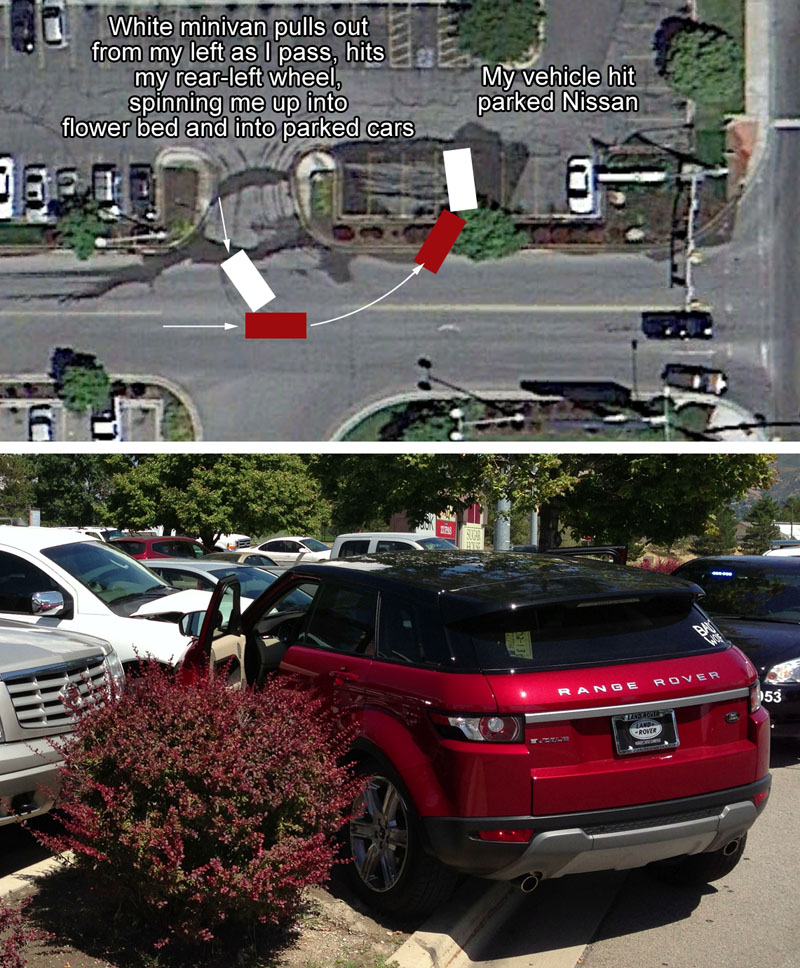
Last week I talked about the lack of observation that plagues drivers nowadays. This week, I'll tell you how my own painful experience relates to that. Remember back in February I ordered a new car, and took delivery of it four weeks ago? Well - a week ago, an inattentive driver caused an accident. So I've been waiting for my car since February, and three weeks after taking delivery, had my first traffic accident in 27 years of driving.
So what happened? Pretty simply really. I was driving along a road that exits a mall, with parking lots either side. A lady pulled out from the parking lot on my left without looking, hit the back-left wheel of my car, and that spun me enough to change my direction to cross oncoming traffic (fortunately there wasn't any), and by the time I'd come to a stop, I'd gone over a small flower bed and into a row of parked cars.
Exactly how this happened is a mystery to me, because she didn't start to pull out until I was actually in front of her. It's not like she pulled out early and cut me off - if that had been the case, I'd have been buried in the side of her minivan. No - she literally drove straight into the side of my car while I was in front of her. I know she kept telling me she didn't see me - which is an excuse I'm used to hearing when riding my motorbike - but a big red car? Didn't see me? How is that even possible?
You might ask 'but Chris - what about YOUR observation? Why didn't you avoid the accident?'. Good question. Easy to answer - she wasn't moving when I started past the intersection, so I didn't see anything to avoid. It came as a hell of a surprise when she ran into me - to start with I had no idea what the hell had happened. That took a moment to sink in, I got on the brakes, and by that time, I was already over the flower bed and that's all she wrote.
So far, the insurance companies aren't willing to write off my car, probably because of the cost of a new one. But the repair bill is now up over $10,000 just for my car alone. Being a brand new model, and being from Europe, I now have to wait at least a month for parts - likely more. I face the spectre of being without it largely until Christmas now. Her insurance company admitted liability for the whole thing, probably because she actually admitted liability on the police report.
So what's next? The airbags didn't go off, so as far as the current inspection and teardown goes, it looks like everything is repairable. The unibody seems untwisted and the crash frame at the front appears untouched. The most damage was to the wheel where she hit me - it destroyed the suspension naturally. But all the stuff up front needs replacing too from where I ended up buried in the parked cars. Bumper, radiator, lights, support structures, rebar etc. But what about diminished value? The car was 3 weeks and 1 day off the lot, with 700 miles on it. I didn't even have a registration plate for it - it was still on delivery tags. At the very least I'm going to pursue her insurance company for some financial compensation there, because I'll never get market value for this car if I have to sell it now it has a crash on it's history. Then there's the special circumstances. A custom-built car, to my specification, that I had to wait four months for? Potentially another three months without it now? I'd like to know what her insurance company has to say about that too.
So what happened? Pretty simply really. I was driving along a road that exits a mall, with parking lots either side. A lady pulled out from the parking lot on my left without looking, hit the back-left wheel of my car, and that spun me enough to change my direction to cross oncoming traffic (fortunately there wasn't any), and by the time I'd come to a stop, I'd gone over a small flower bed and into a row of parked cars.
Exactly how this happened is a mystery to me, because she didn't start to pull out until I was actually in front of her. It's not like she pulled out early and cut me off - if that had been the case, I'd have been buried in the side of her minivan. No - she literally drove straight into the side of my car while I was in front of her. I know she kept telling me she didn't see me - which is an excuse I'm used to hearing when riding my motorbike - but a big red car? Didn't see me? How is that even possible?
You might ask 'but Chris - what about YOUR observation? Why didn't you avoid the accident?'. Good question. Easy to answer - she wasn't moving when I started past the intersection, so I didn't see anything to avoid. It came as a hell of a surprise when she ran into me - to start with I had no idea what the hell had happened. That took a moment to sink in, I got on the brakes, and by that time, I was already over the flower bed and that's all she wrote.
So far, the insurance companies aren't willing to write off my car, probably because of the cost of a new one. But the repair bill is now up over $10,000 just for my car alone. Being a brand new model, and being from Europe, I now have to wait at least a month for parts - likely more. I face the spectre of being without it largely until Christmas now. Her insurance company admitted liability for the whole thing, probably because she actually admitted liability on the police report.
So what's next? The airbags didn't go off, so as far as the current inspection and teardown goes, it looks like everything is repairable. The unibody seems untwisted and the crash frame at the front appears untouched. The most damage was to the wheel where she hit me - it destroyed the suspension naturally. But all the stuff up front needs replacing too from where I ended up buried in the parked cars. Bumper, radiator, lights, support structures, rebar etc. But what about diminished value? The car was 3 weeks and 1 day off the lot, with 700 miles on it. I didn't even have a registration plate for it - it was still on delivery tags. At the very least I'm going to pursue her insurance company for some financial compensation there, because I'll never get market value for this car if I have to sell it now it has a crash on it's history. Then there's the special circumstances. A custom-built car, to my specification, that I had to wait four months for? Potentially another three months without it now? I'd like to know what her insurance company has to say about that too.
Monday, August 26, 2013
A little observation goes a long way.
It never ceases to amaze me how many drivers can't see any further than the end of their own hood. Observation and adaptation, it seems, are dying art forms when it comes to the act of driving. It's become a regular occurrence now for me to see people pull up behind a car that is stopped with its hazard lights on, and then wait through two or three changes of traffic light before they realise that the stopped car isn't going anywhere. Honestly I'm not sure if it's a lack of observation or a lack of common sense. Either way, what normally happens is that they get tired of waiting and then reverse into the traffic behind them, or pull out to go around without looking in their mirrors first. Again - observation.
The same thing happens with target-fixated motorists too. I regularly see drivers follow buses to the side of the road and stop behind them (because the bus is stopping to pick someone up). I've even seen cars follow a bus into a proper bus stop before.
When I'm travelling along a largely empty road with no traffic behind me, it's now quite normal for people to pull out from the side roads in front of me, instead of waiting the extra two seconds to go behind me where there's no traffic. In Utah this is doubly bad because around here people are deathly afraid of acceleration. So when I say "pull out" what I mean is they take their foot off the brake and let the automatic gearbox and idling engine slowly amble them out into the main road, thus becoming an obstruction.
The natural progression of this inattentiveness normally leads to accidents. The most common one around here is people who can't see or hear (apparently) the large red, white and blue trams with bright headlights and loud horns that operate in our streets. The evening news is regularly filled with stories of people trying to turn left in front of moving trams, or trying to race them across intersections. OK in a car it's a little harder to see out and hear the tram maybe, but you'd think that most people would see them as they drive past, before turning in front of them. You'd be wrong. Similarly, pedestrians and cyclists also seem to have a great deal of trouble with trams too. One thing's for sure - the tram never loses.
Finally of course, observation when it comes to pedestrians using phones and iPods isn't a dying art. It's just dead. You just have to assume, as a driver, that these morons are going to step into traffic in front of you without looking. They don't need pedestrian crossings - anywhere will do. And coupled with the increasing inattentiveness of the drivers, you can see where that normally ends up.
The same thing happens with target-fixated motorists too. I regularly see drivers follow buses to the side of the road and stop behind them (because the bus is stopping to pick someone up). I've even seen cars follow a bus into a proper bus stop before.
When I'm travelling along a largely empty road with no traffic behind me, it's now quite normal for people to pull out from the side roads in front of me, instead of waiting the extra two seconds to go behind me where there's no traffic. In Utah this is doubly bad because around here people are deathly afraid of acceleration. So when I say "pull out" what I mean is they take their foot off the brake and let the automatic gearbox and idling engine slowly amble them out into the main road, thus becoming an obstruction.
The natural progression of this inattentiveness normally leads to accidents. The most common one around here is people who can't see or hear (apparently) the large red, white and blue trams with bright headlights and loud horns that operate in our streets. The evening news is regularly filled with stories of people trying to turn left in front of moving trams, or trying to race them across intersections. OK in a car it's a little harder to see out and hear the tram maybe, but you'd think that most people would see them as they drive past, before turning in front of them. You'd be wrong. Similarly, pedestrians and cyclists also seem to have a great deal of trouble with trams too. One thing's for sure - the tram never loses.
Finally of course, observation when it comes to pedestrians using phones and iPods isn't a dying art. It's just dead. You just have to assume, as a driver, that these morons are going to step into traffic in front of you without looking. They don't need pedestrian crossings - anywhere will do. And coupled with the increasing inattentiveness of the drivers, you can see where that normally ends up.
Monday, August 19, 2013
Unintended acceleration = driver error?
I've said this before on my blog, and I'll say it again. I don't believe there's any such thing as "unintended acceleration" in any car made today. Or last year. Or any year for that matter. As far as I can tell, it's "driver had foot mashed on accelerator". The US DoT has a more delicate name for it - 'pedal misapplication'. In November last year, a video showed up that claimed to be hard evidence of unintended acceleration as the video shows a driver ramming a house twice. But careful inspection of the video reveals some very telling evidence - the driver never once tried to use the brake - the brake lights never come on. This particular Toyota has a hard link from the pedal to the brakes - not drive-by-wire - so there's no "electrical gremlins" that can be blamed. Worse still (for the driver at least), Toyota pulled the data from the car's event data recorder (the black box) and showed that, as the video also shows, the brake pedal was never touched. The EDR did however show what I think we all know - the driver mashed their foot on the accelerator for both "events" and that was the cause of the crash shown in the video.
Frankly I was ambivalent about EDRs in cars until I read about this case, but now I think they might be a good idea. People are too happy nowadays to blame their own stupidity on something else, and "unintended acceleration" is the latest symptom of this. The drivers simply won't accept that it was their fault, and so blame all sorts of mysterious things like stuck accelerators, cars driving off on their own, brakes not working etc. So far, in all the cases Toyota have investigate, and all those cases the IIHS and DOT have investigated, I don't recall reading about a single one was caused by problems with the vehicle accelerator or braking systems.
The Noriko Uno case - currently still in the courts - is tragic for sure. She died when her Camry hit a telephone pole at 100 miles an hour. What's curious is that all the press stories tell of how the shifted into neutral, pulled on the emergency brake and did all manner of other things to try to stop before dying. Question : if she died, how do we know what she did? For the car to not slow down at all means either she did none of those things, or that simultaneously, the following items failed on her car : accelerator stuck full open even the her foot off the pedal. Ignition stuck on when the key was pulled out. Emergency brakes failed. Main brakes failed (both circuits). Transmission failed (wouldn't go into neutral when commanded). The likelihood of this happening is, to be honest, absolute zero. The likelihood that Ms Uno panicked with her foot hard down on the accelerator? 100% in my opinion. Sorry to be harsh, but think about it - human error or 6 simultaneous mechanical and electronic failures? Still not sure? Would it help to know that none of those 6 "failures" have ever been reported as single items on any other Camry?
This goes back a long way too - in the 80's, Audi came under fire for similar claims against them with the Audi 5000. Not only did those all turn out to be false, but the '60 Minutes' TV program aired a feature called "Out Of Control" where they claimed to show the Audi 5000 demonstrating unintended acceleration. As it turns out, it did, but only because the show had rigged the car with a compressed air canister hooked into the transmission that could be operated independent of the accelerator so they could make the car accelerate whenever they wanted, even with the driver's foot on the brake. (How 60 minutes rigged an Audi to 'prove' unintended acceleration.
The real issue here is that companies like Toyota get forced into class-action lawsuits that are based on fear rather than grounded in reality, and no matter how much it turns out to be driver error, once a company is forced to pay up for a case they lose, we all pay the price because the cost is inevitably passed on to the consumers. Remember the Toyota lawsuit was only to do with slipping floormats - nothing to do with the mechanical or electrical design of the vehicle systems, and the floormats were only an issue because drivers were putting extra mats on top. So realistically, not even a Toyota problem. But lawyers are lawyers and the sheeple like to be scared, so Toyota lost the case and now we all have to pay more for their cars.
The graph below - reproduced from Car and Driver - shows the problem. That huge spike was everyone jumping on the bandwagon claiming they too had unintended acceleration, trying to get money out of Toyota.
 That in itself irks me - that people are so self-centred nowadays that they'll happily participate in a class action suit like this, because they receive something in the mail and think "Hell yeah! Free money!" But they don't once consider anyone else, or the greater good, and then simultaneously wonder why their next vehicle costs so damn much.
You can see the latest video and Toyota EDR analysis over at Autoblog : Toyota ramming house.
Frankly I was ambivalent about EDRs in cars until I read about this case, but now I think they might be a good idea. People are too happy nowadays to blame their own stupidity on something else, and "unintended acceleration" is the latest symptom of this. The drivers simply won't accept that it was their fault, and so blame all sorts of mysterious things like stuck accelerators, cars driving off on their own, brakes not working etc. So far, in all the cases Toyota have investigate, and all those cases the IIHS and DOT have investigated, I don't recall reading about a single one was caused by problems with the vehicle accelerator or braking systems.
The Noriko Uno case - currently still in the courts - is tragic for sure. She died when her Camry hit a telephone pole at 100 miles an hour. What's curious is that all the press stories tell of how the shifted into neutral, pulled on the emergency brake and did all manner of other things to try to stop before dying. Question : if she died, how do we know what she did? For the car to not slow down at all means either she did none of those things, or that simultaneously, the following items failed on her car : accelerator stuck full open even the her foot off the pedal. Ignition stuck on when the key was pulled out. Emergency brakes failed. Main brakes failed (both circuits). Transmission failed (wouldn't go into neutral when commanded). The likelihood of this happening is, to be honest, absolute zero. The likelihood that Ms Uno panicked with her foot hard down on the accelerator? 100% in my opinion. Sorry to be harsh, but think about it - human error or 6 simultaneous mechanical and electronic failures? Still not sure? Would it help to know that none of those 6 "failures" have ever been reported as single items on any other Camry?
This goes back a long way too - in the 80's, Audi came under fire for similar claims against them with the Audi 5000. Not only did those all turn out to be false, but the '60 Minutes' TV program aired a feature called "Out Of Control" where they claimed to show the Audi 5000 demonstrating unintended acceleration. As it turns out, it did, but only because the show had rigged the car with a compressed air canister hooked into the transmission that could be operated independent of the accelerator so they could make the car accelerate whenever they wanted, even with the driver's foot on the brake. (How 60 minutes rigged an Audi to 'prove' unintended acceleration.
The real issue here is that companies like Toyota get forced into class-action lawsuits that are based on fear rather than grounded in reality, and no matter how much it turns out to be driver error, once a company is forced to pay up for a case they lose, we all pay the price because the cost is inevitably passed on to the consumers. Remember the Toyota lawsuit was only to do with slipping floormats - nothing to do with the mechanical or electrical design of the vehicle systems, and the floormats were only an issue because drivers were putting extra mats on top. So realistically, not even a Toyota problem. But lawyers are lawyers and the sheeple like to be scared, so Toyota lost the case and now we all have to pay more for their cars.
The graph below - reproduced from Car and Driver - shows the problem. That huge spike was everyone jumping on the bandwagon claiming they too had unintended acceleration, trying to get money out of Toyota.

You can see the latest video and Toyota EDR analysis over at Autoblog : Toyota ramming house.
Monday, August 12, 2013
Guest post : 4 Types of Classic Car Owners
People collect classic cars for all sorts of reasons, but there are 4 types of people who you will most likely find wandering around dealerships, pitching a tent at weekend conventions and scanning through the classifieds looking for great deals.
1. Reggie Restorer
Restorers are the ones like to boast about that “wreck” they picked up twenty years ago and converted to a first class machine that would make any classic car enthusiast drool. These individuals tend to pay next to nothing for the cars they purchase because they’re almost scrap metal when they find them. They usually get their enjoyment from spending hours tirelessly working away at the cars, gently coaxing them back to life with their dedication and knowledge of engineering. No project is too big for these guys, which is precisely why it isn’t a calling for the faint of heart.
2. Captain Collector
Collectors have a lot of money to spend on their vehicles, and they are usually in it for the prestige and the love of driving some of the most expensive classic cars in San Diego. It is quite usual to find at least five or more vehicles standing in the garages of collectors, and they’re always looking to acquire something else. A collector often has one or two cars that they are really proud of, which don’t get driven very often, while the others are taken out every other weekend to show them off.
3. Percy Perfectionist
These collectors tend to pride themselves on the condition of their vehicles, rather than the diversity or the cost of their purchases. You’ll most likely find perfectionists busy waxing their vehicles into the early hours of the evening, while in the morning it’s not uncommon to see them cycling to work for fear that they might damage their vehicle in some small way.
4. Tommy Race Track
While some people like to keep their collection locked up in a garage, others like to fix old cars up so that they can take them out on the racetrack and give others a run for their money. You will find just about every collectable on the market on one of these tracks, including amalgamations of various makes and models.
Collectors come in all shapes and sizes, but it is a love for vehicles that they all have in common, and this makes for some interesting characters. Click here for more information on Classic Cars San Diego.
1. Reggie Restorer
Restorers are the ones like to boast about that “wreck” they picked up twenty years ago and converted to a first class machine that would make any classic car enthusiast drool. These individuals tend to pay next to nothing for the cars they purchase because they’re almost scrap metal when they find them. They usually get their enjoyment from spending hours tirelessly working away at the cars, gently coaxing them back to life with their dedication and knowledge of engineering. No project is too big for these guys, which is precisely why it isn’t a calling for the faint of heart.
2. Captain Collector
Collectors have a lot of money to spend on their vehicles, and they are usually in it for the prestige and the love of driving some of the most expensive classic cars in San Diego. It is quite usual to find at least five or more vehicles standing in the garages of collectors, and they’re always looking to acquire something else. A collector often has one or two cars that they are really proud of, which don’t get driven very often, while the others are taken out every other weekend to show them off.
3. Percy Perfectionist
These collectors tend to pride themselves on the condition of their vehicles, rather than the diversity or the cost of their purchases. You’ll most likely find perfectionists busy waxing their vehicles into the early hours of the evening, while in the morning it’s not uncommon to see them cycling to work for fear that they might damage their vehicle in some small way.
4. Tommy Race Track
While some people like to keep their collection locked up in a garage, others like to fix old cars up so that they can take them out on the racetrack and give others a run for their money. You will find just about every collectable on the market on one of these tracks, including amalgamations of various makes and models.
Collectors come in all shapes and sizes, but it is a love for vehicles that they all have in common, and this makes for some interesting characters. Click here for more information on Classic Cars San Diego.
Subscribe to:
Posts (Atom)